Premises Liability & Risk Management on Communal HOA Grounds
Under Georgia premises liability law (O.C.G.A. § 51-3-1), property owners, homeowner association boards, and commercial property management companies owe an active, non-delegable duty of care to invitees, residents, guests, and maintenance contractors to keep common grounds reasonably safe. Tree stumps located along unlit pedestrian sidewalks, dog park enclosures, swimming pool walkways, playground borders, and clubhouse walking trails represent classic, actionable trip-and-fall hazards.
A resident or tenant who trips over a low-cut stump or an exposed lateral root collar can suffer severe injuries, including fractured wrists, broken hips, torn ligaments, or concussions. In Cobb County civil courts, personal injury litigators and commercial insurance adjusters routinely cite unaddressed, weathered tree stumps as prima facie evidence of deferred maintenance and negligent premises oversight.
Eliminating these hazards through commercial below-grade grinding 8 to 12 inches deep removes immediate premises liability exposure, eliminates hazardous surface root ridges, and directly satisfies annual commercial property casualty insurance audits. When an HOA proactively removes trip hazards, the board insulates itself from costly claims and protects community reserves.
HOA & Property Management RFP Specification Matrix
Drafting an enforceable Request for Proposal (RFP) requires clear technical specifications so commercial landscape contractors, arborists, and dedicated stump grinding specialists submit apples-to-apples bids. The following specification matrix outlines standard municipal, safety, and administrative requirements for commercial multi-family parcels across Cobb County:
| Specification Category | Municipal & Legal Standard | Contractor Requirement | Property Deliverable |
|---|
| Premises Liability & Safety | O.C.G.A. § 51-3-1 Active Duty of Care | 8–12" below-grade grinding with surface lateral removal | Zero pedestrian trip-hazard sign-off |
| Underground Utilities | Georgia 811 Dig Law (O.C.G.A. § 25-9-1) | Mandatory e-ticket locate & private irrigation survey | PRIS ticket confirmation & depth verification |
| Property & Vehicle Protection | OSHA Debris Containment Protocol | Modular ballistic screening & designated zone spotters | Zero projectile damage guarantee around tenant vehicles |
| Turf & Infrastructure Care | HOA Common Area Covenants | Sub-36" machine width, rubber tracks & turf mats | Zero rutting or compaction on manicured berms |
| Municipal Tree Preservation | Marietta Zoning Ordinance Div 712.08 | Tree Density Unit (TDU) buffer compliance | Cleared grade ready for replacement planting |
| Vendor Administration | CAM & Corporate Accounting Protocol | W-9, $2M COI additional insured, tiered volume billing | Itemized invoicing with geo-tagged photo proof |
Enforcing Neighborhood Aesthetics & Protecting Community Valuations
In master-planned communities across Marietta, East Cobb, Kennesaw, and Alpharetta, homeowner association covenants and architectural review committees enforce rigorous curb appeal and landscaping standards. Decaying stumps, wild root suckers, invasive fungal shelf brackets (such as Ganoderma lucidum), and decaying wood rot diminish neighborhood aesthetic consistency and signal neglected community upkeep to prospective home buyers.
Furthermore, unattended hardwood stumps attract subterranean termite colonies (Reticulitermes flavipes) and carpenter ants, which establish satellite nests on common property before migrating toward residential foundations and clubhouse framing.
By establishing an annual or bi-annual commercial stump sweep agreement with On The Grind, HOA boards ensure that storm-felled or newly removed tree stumps are systematically eliminated from common greenways, retention basin borders, and resident front easements within 48 to 72 hours of tree felling. Cleanly ground sites can be immediately re-seeded with bermuda or fescue sod, maintaining cohesive property values.
Safety Containment & Ballistic Shielding Around Tenant Vehicles
Operating high-horsepower commercial stump grinders in high-density multi-family environments—such as apartment parking bays, corporate office parks, condominium courtyards, and townhouse cul-de-sacs—demands rigorous debris containment protocols. Commercial cutting wheels spin carbide teeth at peripheral speeds exceeding 100 miles per hour, capable of launching loose gravel, root nodules, and wood fragments over fifty feet.
Our crews set up modular ballistic debris containment curtains around every active grinding perimeter before engaging the cutter wheel. These heavy-duty screens absorb and isolate high-velocity debris, completely protecting parked tenant vehicles, glass commercial storefronts, air conditioning condensing units, and passing pedestrians.
We coordinate dedicated ground spotters who maintain continuous 360-degree situational awareness, temporarily idling the machine whenever residents, delivery couriers, or pets enter the outer safety perimeter.
Drafting an Annual Greenway Maintenance RFP and Stump Inventory Sheet
For commercial facilities managers and HOA landscape committees, budgeting for tree work can be erratic if managed reactively on a one-off basis. We assist property managers in creating structured, predictable tree maintenance scopes. By conducting a walk-through inspection twice annually—typically in early spring following winter ice storms and in late autumn after hurricane remnants have passed—we generate a comprehensive stump inventory sheet.
This inventory documents the exact GPS location, basal flare diameter, tree species, proximity to utilities, and accessibility constraints for every stump across the property. We provide an itemized master bid with tiered volume discounts, allowing board members to vote on transparent, all-inclusive pricing with zero hidden surcharges, travel fees, or unexpected change orders.
Emergency Storm-Response SOW: Standby Mobilization for Fallen Pine Stumps
North Georgia severe thunderstorms, summer microbursts, and winter ice storms routinely down mature Loblolly pines and water oaks across Cobb County subdivisions. When emergency tree services perform rapid cut-and-drop clearing to open blocked community access roads, they leave behind massive root wads and splintered trunk bases that block drainage swales and create immediate hazards.
On The Grind provides priority commercial mobilization for property managers managing storm aftermath. Our commercial-grade equipment can quickly grind out heavy root wads 10 to 12 inches below grade, shredding splintered taproots and turning tangled debris into manageable mulch. This rapid intervention allows municipal storm drainage to flow freely, prevents retention pond overflow, and readies common areas for swift landscape restoration.
Underground Infrastructure Coordination in Multi-Family Complexes
Multi-family residential complexes and commercial office parks feature an intricate maze of subgrade infrastructure that extends far beyond municipal street mains. While calling Georgia 811 (O.C.G.A. § 25-9-1) is legally mandatory and identifies public utility mains (such as Atlanta Gas Light high-pressure pipes, Cobb EMC power, and municipal water), public utility locators do not mark private underground infrastructure.
Private property features—including multi-zone commercial sprinkler manifolds, low-voltage landscape lighting cables, gated security access wiring, and dog park water lines—are routinely buried within the top 6 to 10 inches of soil where tree roots interweave. Our technicians work directly with property facility directors and on-site landscape engineers to review irrigation plans, map private line routes, and perform delicate hand-probing within the 18-inch tolerance zone prior to mechanical grinding.
Procurement Simplicity: W-9s, COIs, and Remote Geo-Tagged Photo Reporting
We understand the administrative demands placed on regional property managers and community association management (CAM) executives managing dozens of properties. We make vendor onboarding and invoicing completely frictionless:
- Active W-9 forms and municipal commercial licensing documentation provided on demand.
- Comprehensive Commercial General Liability insurance certificates ($2,000,000 aggregate) with property management entities named as additional insureds.
- Itemized electronic invoicing matching your purchase order requirements and vendor portals (such as RealPage, Yardi, or OpsTechnology).
- High-resolution, geo-tagged before-and-after photo portfolios for remote property managers overseeing Cobb County assets from Atlanta or out-of-state regional offices.
Navigating Marietta Zoning Ordinance Division 712 on Commercial Parcels
Unlike private single-family homeowners who enjoy broad exemptions from municipal tree removal permitting, commercial developments, multi-family apartment communities, and corporate office campuses in Marietta are subject to Marietta Zoning Ordinance Division 712. Under Section 712.08, any commercial site plan modification or tree canopy clearing must maintain required Tree Density Units (TDUs) per acre and preserve designated landscape buffer strips.
When commercial tree removal occurs following storm events or arborist hazard evaluations, grinding the remaining stumps is standard protocol. However, property managers must ensure that the cleared areas align with approved commercial landscape conservation plans. On The Grind coordinates closely with commercial facilities directors to confirm that stump grinding activities respect commercial perimeter buffers and prepare cleared ground for required replacement canopy plantings.
Turf Protection on High-End HOA Berms and Sports Amenities
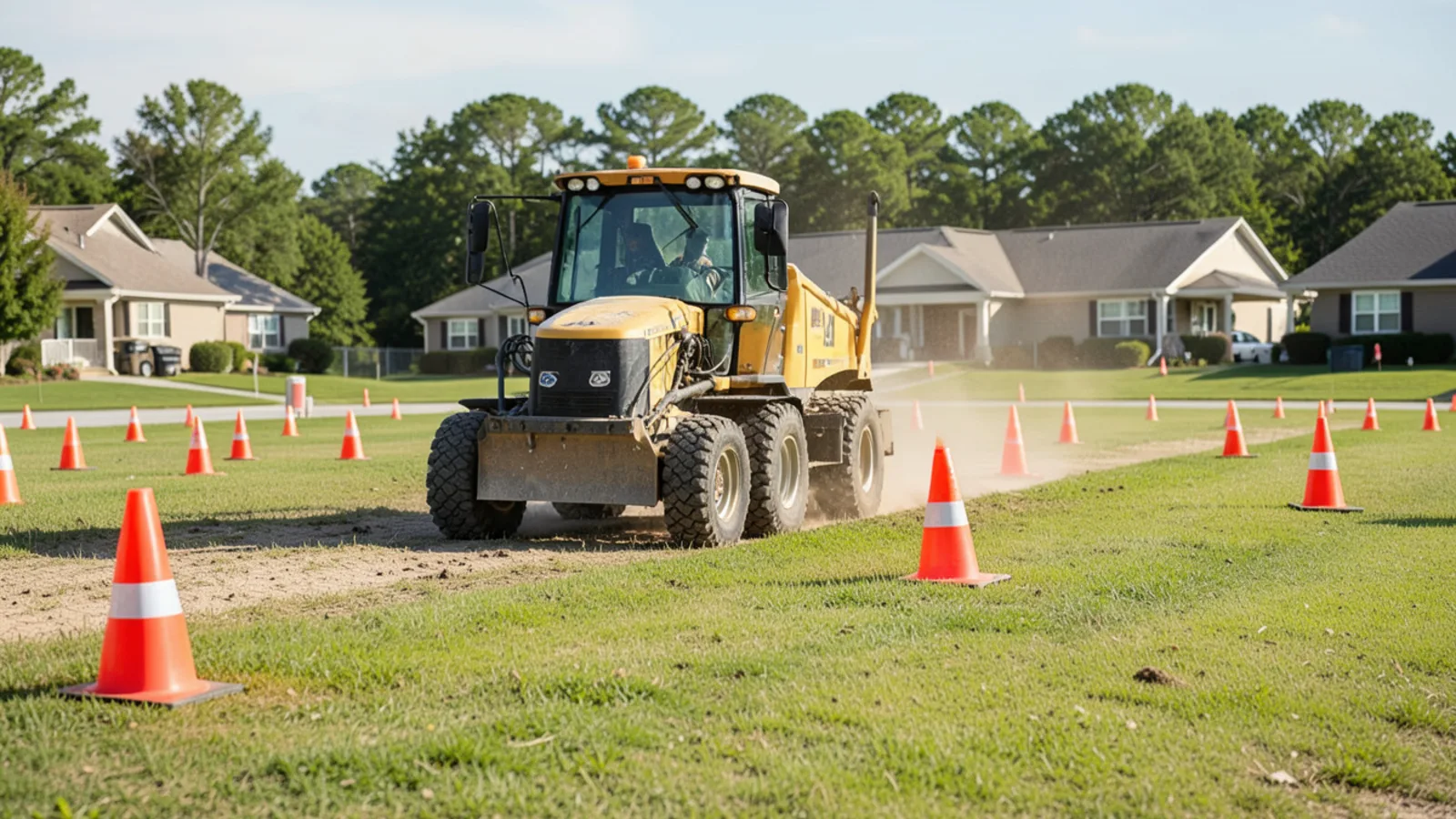
Commercial HOA properties frequently feature expensive community amenities, including championship tennis courts, swimming pool cabanas, and manicured Bermuda grass sports fields. Operating heavy machinery across these delicate recreational surfaces can cause deep tire gouging and destroy underground irrigation mainlines.
Our commercial operations utilize low-ground-pressure rubber-tracked machinery designed specifically to disperse machine weight evenly across turf. In sensitive areas bordering clubhouses and golf fairways, our crew lays high-density interlocking ground protection mats to create a smooth, temporary roadway. This ensures our 40-horsepower grinders can navigate directly to the stump collar without disturbing manicured turfgrass or compacting subsoil.
Volume Tier Pricing: Maximizing HOA Budget Allocations
The most cost-effective way for property managers to handle tree stumps is through bulk scheduling. Mobilizing commercial machinery carries fixed overhead; by clustering multiple stumps across a community into a single service sweep, we offer substantial volume tier discounts based on total stump count. Whether you need five pine stumps cleared from an apartment courtyard or thirty hardwood stumps removed from an HOA greenway, our team delivers unmatched speed and value. Contact our commercial division at (321) 677-9055.