
Updated 2026-10-22·10 min read·By On The Grind Stump Removal Arborist Team
Why We Call Georgia 811 Before Grinding a Stump
Yes, calling Georgia 811 before stump grinding is legally mandatory under O.C.G.A. § 25-9-1 because high-speed cutting wheels penetrate 6 to 18 inches below grade, directly into zones where gas, power, water, and fiber-optic cables run. Calling 811 is a free service that prevents catastrophic line strikes, neighborhood utility outages, explosion risks, and tens of thousands in repair liability.
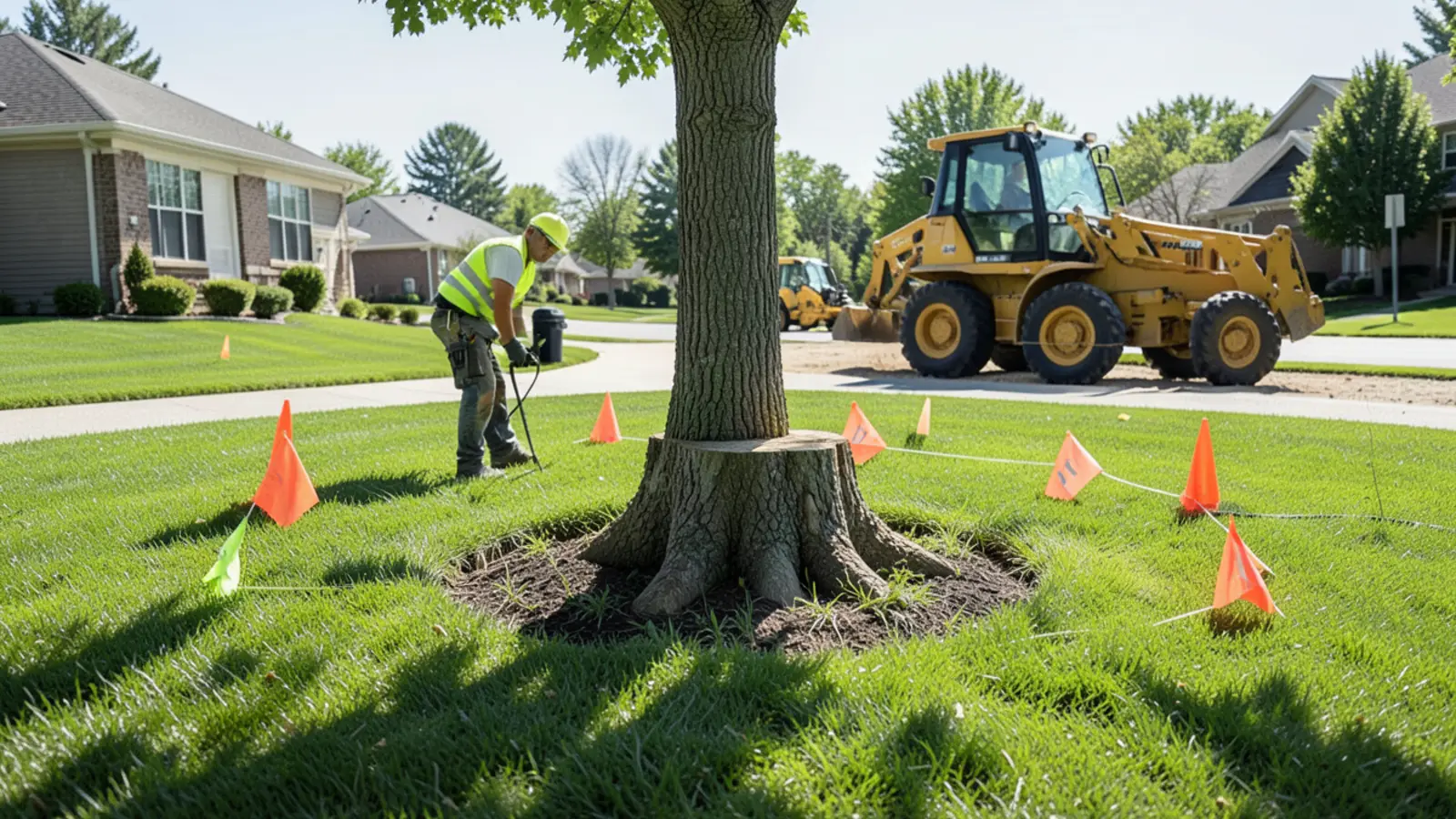
Mandatory Georgia 811 Utility Locate
35" Narrow Gate Access
4" to 12"+ Grind Depth
Complete Chip Cleanup & Backfill
Fast Phone & Photo Estimates
The Legal Mandate: Georgia Utility Facility Protection Act (O.C.G.A. § 25-9-1)
Under Georgia law, anyone planning to perform mechanized excavation or digging must notify Georgia 811 at least three business days prior to commencing work. Stump grinding wheels operate at high rotational velocity (often exceeding 1,000 RPM) and penetrate 6 to 18 inches below the surface of the soil. Legally, mechanical stump grinding is classified as mechanized excavation.
Failing to submit a utility locate ticket before grinding carries severe civil penalties under Georgia law, with fines reaching up to $10,000 per violation. More importantly, if an unlicensed contractor or homeowner strikes a high-pressure natural gas line or fiber-optic trunk without a valid locate ticket, they are held financially liable for 100% of emergency response costs, system repairs, and potential damages from service outages.
Why Tree Roots Wrap Around Underground Pipes and Cables
Homeowners often wonder how utility conduits end up directly entangled in tree roots. The explanation lies in tree biology and urban installation history. When utility companies trench through residential neighborhoods to install gas laterals, water mains, or underground telecommunications cables, the backfilled trench soil is looser and retains more moisture than native compacted red clay.
Tree roots naturally follow the path of least mechanical resistance and highest moisture. Over thirty to fifty years, lateral tree roots seek out these utility trenches, intertwining with PVC gas conduits, copper water services, and coaxial lines. In some cases, a tree was planted directly over an existing utility easement decades ago. In other instances, shallow telecommunications lines (such as high-speed fiber internet) were trenched directly through the surface root flare of an existing mature tree just three to four inches beneath the lawn sod.
Understanding Georgia 811 APWA High-Visibility Color Codes
When Georgia 811 locates your property, professional utility locators spray temporary water-based marking paint and insert colored pin flags in accordance with the American Public Works Association (APWA) uniform color code. Understanding these color markers allows homeowners and contractors to immediately visualize subterranean corridors before machinery begins operating.
| APWA Color | Utility Infrastructure Type | Typical Burial Depth | North Metro Public Operators |
|---|---|---|---|
| Red | Electric power lines, high-voltage cables & street lighting | 18 to 36 inches | Georgia Power, Cobb EMC |
| Yellow | Natural gas laterals, high-pressure mains & petroleum pipes | 12 to 24 inches | Atlanta Gas Light (AGL), Austell Gas |
| Orange | Telecommunications, high-speed fiber-optic & cable TV | 4 to 12 inches (very shallow) | AT&T, Comcast / Xfinity, Google Fiber |
| Blue | Potable drinking water mains & residential water service | 24 to 48 inches | Cobb County Water System, City of Marietta |
| Green | Sanitary sewer lines, storm drains & lateral culverts | 36 to 96+ inches | Marietta Water, Cobb County Water |
| White | Proposed excavation boundary delineated by contractor | Surface paint only | On The Grind Stump Removal crews |
Real Metro Atlanta Line Strike Scenarios & Cost Consequences
Striking a buried utility line is not merely an inconvenience; it carries catastrophic financial and safety consequences. In Cobb and Fulton counties, natural gas lines installed by Atlanta Gas Light (AGL) typically operate under 30 to 60 PSI of pressure. If a high-speed stump grinder tooth punctures a plastic gas lateral, leaking gas saturates the soil and migrates toward nearby crawlspaces and basements, triggering mandatory neighborhood evacuations and emergency fire department dispatch.
Similarly, fiber-optic telecommunications lines installed by AT&T or Comcast are frequently direct-buried barely four to six inches deep in front yards. Slicing through a fiber-optic cable with a stump grinder can sever high-speed data connections for an entire subdivision or commercial business park. Repairing a severed 144-strand fiber-optic cable routinely incurs specialized splicing costs exceeding $15,000 to $30,000—charges billed directly to the responsible party if work was performed without a verified 811 ticket.
The 18-Inch Tolerance Zone: Hand-Digging & Soft Excavation Rules
Georgia law mandates a strict "tolerance zone" extending eighteen inches horizontally from either side of a marked utility facility. Inside this tolerance zone, the Georgia Utility Facility Protection Act prohibits mechanical equipment from cutting directly into the ground until the utility has been visually exposed through non-destructive means.
When a tree stump sits inside an active tolerance zone, our technicians implement soft excavation protocols:
• Fiberglass Hand-Probing: We probe the subsoil with non-conductive, insulated fiberglass probes to physically locate the utility pipe without risking puncture.
• Manual Root Clearing: If a utility lateral is wedged beneath a lateral root flare, we use manual hand saws and chisels to separate the wood collar from the conduit, avoiding high-speed mechanical cutter wheel contact.
• Defensive Ballistic Shielding: We position heavy rubber deflection curtains between the rotating cutter wheel and the exposed utility corridor to prevent stray stones or dislodged wood fragments from impacting pipes.
Contractor Liability vs. Homeowner Responsibility: Who Pays When Lines Break?
A frequent point of confusion among Marietta homeowners is legal and financial liability during tree service operations. Under Georgia statute, the individual or entity performing the mechanical excavation is primarily responsible for requesting the 811 ticket. When you hire On The Grind, our team submits the ticket, tracks the three-day clearance window, and verifies positive responses from all member utilities before equipment tracks ever touch your lawn.
Conversely, if you hire an unlicensed, informal "tree guy" who tells you "we do not need to call 811 for a simple stump," you are taking an enormous financial risk. If that operator hits an unmarked gas or fiber line and flees the scene, utility companies and municipal authorities frequently pursue the property owner for repair costs and civil damage claims. Always demand to see an active Georgia 811 ticket confirmation number before allowing any mechanical grinder to operate on your property.
The Positive Response System: Verifying Electronic Clearance Before Work Begins
Submitting an 811 locate ticket is only the first step in Georgia’s damage prevention process. Before any mechanical cutting wheel begins grinding, both contractor and homeowner must confirm that every affected utility has responded via the Georgia 811 Positive Response Information System (PRIS).
Under state regulations, each notified utility member must electronically update the ticket with standardized disposition codes:
• Code 10 (Clear / No Conflict): The utility has reviewed geographic GIS mapping and determined that no public infrastructure exists within the delineated white work boundary.
• Code 30 (Marked): Utility technicians have visited your property and marked the underground pipes or cables with high-visibility APWA surface paint and colored flags.
• Code 999 (Overhead Only / Not Affected): The facility owner operates strictly above-ground lines that will not be impacted by subterranean cutting.
At On The Grind, our operations manager reviews the electronic PRIS dashboard on the morning of your appointment. If any utility remains unverified or in "delayed" status, we follow up directly with their dispatch team to ensure 100% positive verification before our machinery operates. This electronic and physical cross-check provides absolute legal protection and peace of mind for every homeowner.
Public vs. Private Utilities: What Homeowners Must Know
It is critical to understand that Georgia 811 locators mark only public utility lines maintained by utility companies up to the service meter. They do not locate private underground lines, such as low-voltage landscape lighting wiring, subterranean dog fence boundaries, propane lines running from a private tank to a grill, or lawn sprinkler system plumbing. Ahead of our visit, our dispatcher asks homeowners to flag known private irrigation heads and low-voltage wires so our team can safely navigate around them.
If you are uncertain where private irrigation lines run, private utility locating companies can be hired, or our crew can carefully probe the top six inches of topsoil with hand trowels around the stump collar. Taking these preliminary precautions prevents costly irrigation pipe breaks and ensures your landscaping infrastructure remains completely undamaged throughout the grinding process.
Need Help with a Tree Stump in Marietta?
Call our local East Cobb team at (321) 677-9055 for an instant, tape-measured phone quote.
No forms to fill out · Fast answers from local specialists · Georgia 811 utility safe
Frequently Asked Questions
No. Georgia 811 is a free public safety service funded by utility member companies. Submitting an excavation locate ticket costs nothing for homeowners or contractors.